
I Cried in a Bathroom Stall on 9/11, Then America Took Custody of My Panic
How private fear becomes national belonging, and why grief is so easy to recruit.

This is the abridged version. There’s a longer one with the full argument, more citations, and considerably more of my own baggage on display. It’s free, here.
Honestly, it’s a lot better. It also has a Jello Salad recipe. So.
I was a junior in high school cramming my calculus book into my locker when my brother came up to me and informed me a plane had hit the World Trade Center tower.
How? I asked him. I had no real idea what the Twin Towers were, I was sixteen and had the geopolitical confidence of someone who had recently failed to parallel park. He was my younger brother, though, so I pretended harder.
I don’t know, he said, but that’s where Uncle David works.
That landed.
I loved Uncle David. He was one of the fun uncles in my dad’s large family, the kind of uncle who talked to you at holidays instead of disappearing into the room where the football game was on.
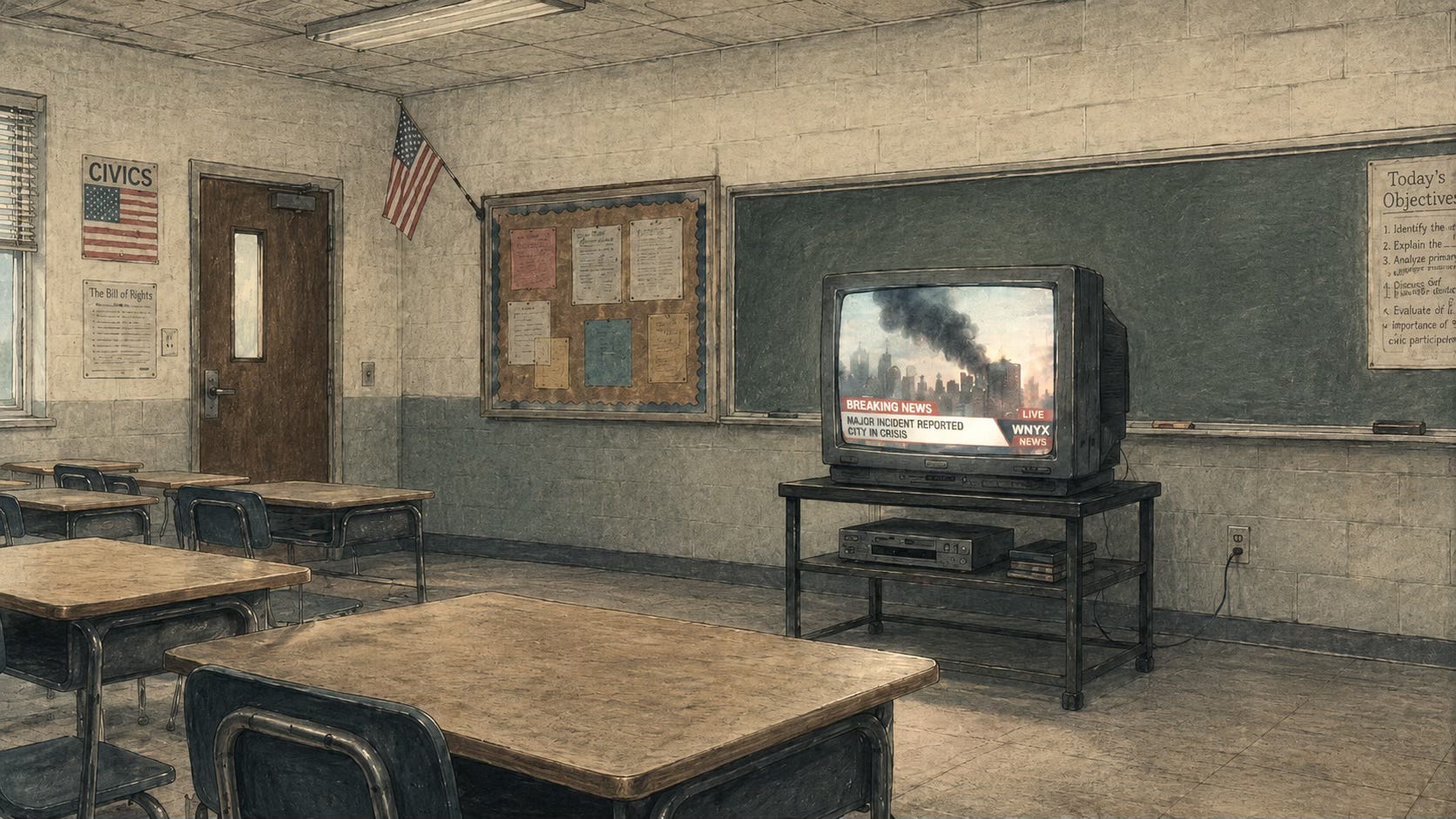
I went to class in a daze. Our chemistry classroom had one of those old box TVs mounted on the wall and it was turned to the news. We watched the second plane hit the South Tower live, thirty teenagers sitting in metal chairs, still wearing backpacks and lip gloss and football hoodies, still half-worried about homework and who liked us and whether our hair looked stupid, all while the adult world tore open on a television in the front of the room.
I asked for a bathroom pass and cried in a stall until a teacher came to find me. She turned off the television and we returned to the periodic table. Later, a note came from the office. My mom had called to tell them Uncle David was alive and well.
I remember very little of the days after, at least not in order. What I remember is anger, fear, and a conviction that we were a country worth fighting for. There was an odd tenderness in it too, a collective gentleness that follows mass horror, right up until it curdles into something more useful to men in suits.
What I do remember with absolute clarity is the music. It was Alan Jackson and Toby Keith, Enya over disaster footage, Springsteen trying to make grief bearable, and eventually Darryl Worley asking whether we had forgotten, like we possibly could.
That September I sat on a riding mower, moving in slow rows over my family’s property while Lee Greenwood looped through my headphones. I could not stop listening to that one song.
God Bless the USA.
Over and over.
I was not thinking about empire, or vengeance, or war. I was a teenage girl on a lawnmower trying to make her mind stop seeing a plane hit a building where her uncle worked.
The Star Spangled Attachment Wound
No offense to the republic, but the nervous system did not evolve to attach itself to 330 million strangers and a federal tax code. It was responding to a name my brother said at my locker, which my nervous system immediately filed under people I cannot afford to lose.
The medial prefrontal cortex has been sorting your social world since childhood, automatically dividing it into familiar and unfamiliar, mine and not mine, us and them (Amodio & Frith, 2006; Mitchell et al., 2006). The amygdala scans for threat underneath that, and gets loudest when you’re witnessing danger to someone already filed as yours, firing before your conscious mind has caught up (Adolphs, 2008; Shamay-Tsoory & Abu-Akel, 2016). When my brother said Uncle David’s name, the medial prefrontal cortex opened the file then the amygdala pulled the alarm.
Most Americans will never meet each other. We will not sit at the same tables or know who gets weird after two drinks at Thanksgiving. And yet we still feel close to people we’ve never met - a fellow American, a Hoosier, a Cubs fan.
Benedict Anderson called this an imagined community, a felt sense of shared life among people who will never actually share a life (Anderson, 2006). Real intimacy takes decades of shared meals and grudges to build. A nation doesn’t have that kind of time, so it mass-produces closeness by, using flags, anthems, memorials, and news footage as delivery mechanisms for attachment, especially when the people on screen look threatened, grieving, or ours (Anderson, 2006).
On the lawnmower that September day, it felt like Lee Greenwood was giving me a civics lesson. He was actually giving my panic somewhere to go and a country happy to take custody of it.
The Olympics-to-Marydom Pipeline
Sorting the world into clean categories — safe or threatening, us or them — is the brain’s preferred shortcut, and under normal conditions it’s morally neutral.
It only gets dangerous when a group identity stops being something you merely hold and becomes something you can’t negotiate with. Researchers call this a sacred value: a belief so central to the self that no offer, however good, can buy it off.
A neuroimaging study of jihadists willing to fight and die for their cause found reduced activity in the brain regions responsible for deliberation and consequence-weighing (Hamid et al., 2019).
The same study found that people with similar beliefs who had not yet fused their identity to the cause were still swayable by peers. I would argue fusion is the gateway drug to extremism.
Identity fusion is what happens when the line between you and the group dissolves, when the group’s fate becomes something you feel in your own chest, the way you might feel a sibling’s crisis. People who are highly fused with a group are more willing to fight and sacrifice for it, because on some level they are fighting for themselves (Swann et al., 2010).
Under threat, the brain doesn’t need a real, present danger to start guarding the tribe, it just needs the reminder that you’re going to die someday. When people are made briefly aware of their own mortality, they cling harder to the worldviews that make life feel meaningful, and they get warmer toward people who share those worldviews and colder toward people who don’t (Greenberg et al., 1990; Burke et al., 2010).
You realize in that moment that you are simply meat with a stopwatch, and your brain would like some company in acknowledging that horror.
Mass casualty events hand you both ingredients at once: a real threat, and a whole population suddenly and involuntarily thinking about death.
The Enemy Was Easier Before Dinner
Six months after the towers fell, I was sitting on the floor of our family’s Florida condo while my mom braided my hair and George W. Bush announced the war in Iraq.
I was elated.
At seventeen I thought war meant safety was coming back, that force would fix things, that Uncle David’s nerves would finally settle. My mother told me, in the dry and unimpressed tone of someone explaining a very obvious thing to a teenager who has lost the plot, that war was not a game.
Six months after that, I moved to the Czech Republic to teach English, then Spain, then England, where I lived with seven women whose parents came from seven different countries and where we celebrated Eid with the same gusto as Christmas.
I’ve since spent real time in rural Guatemala, Uganda, Kenya, and India, and I do not feel the way about American superiority that I did at seventeen on that condo floor.
Living inside other people’s worlds made us and them much harder to keep clean. The Ugandan orphan became us. The Czech atheist became we. What reliably moves people is contact with someone on equal footing, working toward a shared task, without a scarce prize turning the whole thing into a competition, and repeated often enough that it becomes the norm (Pettigrew & Tropp, 2006). Once you’ve watched someone’s kid throw up at a birthday party, that’s just how those people are gets a lot harder to say.
I have to be careful here, because the honest research is not travel cures prejudice. The contact with the outgrip has to be mostly good. One miserable trip abroad can spike stereotyping not just toward the country that ruined it, but toward outgroups that had nothing to do with the trip at all (Paolini et al., 2024).
Which is why none of this can be legislated into you. Nobody can mandate equal-status cooperation onto a frightened nervous system. You have to actually build the relationship.
The Emotional Draft
My mother was right, something I report with the enthusiasm of every daughter who has ever had to say that sentence out loud. War was not the cheerful thing my seventeen-year-old brain wanted it to be, and it was never going to make that day I cried in the bathroom for my uncle go away.
At sixteen I did not know enough to be suspicious of relief that arrived wearing the face of revenge. I wanted the bad thing to stop, and I wanted the people I loved to be safe. In hindsight, that is not a sophisticated political position, but it is an extremely common one.
The worst things people do for their ingroups rarely begin with hatred. They begin with fear, love, grief, loyalty, and the knowledge that someone can leave the house in the morning and come back as a name everyone is waiting to hear on the news.
When a country feels frightened, people start looking for a larger us.
That impulse is old. Our ancestors survived threat by forming coalitions, pulling nearby groups into temporary alliance when danger got too close. Fear still does that. It stretches belonging past anyone you actually know, until your circle includes 330 million strangers whose only real connection to you is a flag.
You will never borrow their Tupperware. You will never eat their deviled eggs in a church basement. You will never know which of them put raisins in the potato salad and should therefore be monitored by federal authorities. But under threat, their fate can start to feel tied to yours.
That is the shortcut version of belonging. The circle gets bigger because the danger gets bigger.
The slower version is contact. Real people, in the real world, close enough to complicate your categories. People who may not share your skin color, language, religion, or politics, but who can become part of your actual life instead of your imagined tribe.
Actual people can show up for you. The nation can inspire you, frighten you, organize you, flatter you, and tell you a story about who belongs. But the nation is not going to sit beside you in the ER, bring soup, feed your dogs, or notice that you have stopped answering texts.
Gordon in New Mexico may share your flag. He is still not part of your life.
I still have the note from the office: Uncle David is alive and well I have kept it for more than twenty years, a small piece of paper from the last few hours before my country learned how to speak in his voice.
My country’s skies are bluer than the ocean,
And sunlight beams on cloverleaf and pine;
But other lands have sunlight too, and clover
And skies are everywhere as blue as mine.
— Lloyd Stone
Further Reading
On Nations as Emotional Architecture
Imagined Communities, Benedict Anderson
Anderson’s argument is that a nation works because people who will never meet each other agree to feel related anyway. It gets academic in places but the payoff is worth it. Once you have the vocabulary, you cannot watch the Olympics the same way again.
Banal Nationalism, Michael Billig
Anderson explains why the bond exists. Billig explains how it gets refilled every day through flags outside gas stations, weather maps, and the pronouns news anchors use without noticing.
The Righteous Mind, Jonathan Haidt
Haidt overreaches in places, and plenty of researchers have pushed back on parts of his model, so read this as a useful map, not scripture. What he does well is explain why moral belief turns tribal so fast, and why arguing someone out of a belief they experience as sacred rarely works the way you think it will.
Tribe, Sebastian Junger
Not peer reviewed and not pretending to be, which makes it the right on-ramp if you want more without wanting homework. Junger’s argument, that modern life stripped away belonging structures humans evolved to need, overlaps with everything above without requiring you to already know what identity fusion means.
On Sacred Values and Dying for the Group
Talking to the Enemy, Scott Atran
Atran spent years talking to actual people willing to die for a cause, which puts this several notches above anyone theorizing from a conference room. This is the sacred values argument with faces attached, and it explains why offering someone money to abandon a moral commitment can make them angrier instead of more reasonable.
On 9/11, Grief, and the National Story Machine
The Terror Dream, Susan Faludi
The strongest match in tone and subject on this list. Faludi tracks how American mythmaking after September 11 reorganized itself around old scripts of heroism, vulnerability, masculinity, and protection, and she writes with enough precision that the argument lands instead of just informing you. If you read one book from this list for pleasure, make it this one.
Overblown, John Mueller
The receipts behind the claim that threat gets manufactured and sold, not simply perceived. Mueller uses real data to show how officials and media inflate danger after an attack, and how that inflation tends to serve interests that have very little to do with anyone’s actual safety.
Library first, always, but if you buy through an Amazon link, As an Amazon Associate I earn from qualifying purchases. There is no additional cost to you.
References
Adolphs, R. (2008). Fear, faces, and the human amygdala. Current Opinion in Neurobiology, 18(2), 166–172. https://doi.org/10.1016/j.conb.2008.06.006
Amodio, D. M., & Frith, C. D. (2006). Meeting of minds: The medial frontal cortex and social cognition. Nature Reviews Neuroscience, 7(4), 268–277. https://doi.org/10.1038/nrn1884
Anderson, B. (2006). Imagined communities: Reflections on the origin and spread of nationalism (Rev. ed.). Verso.
Burke, B. L., Martens, A., & Faucher, E. H. (2010). Two decades of terror management theory: A meta-analysis of mortality salience research. Personality and Social Psychology Review, 14(2), 155–195. https://doi.org/10.1177/1088868309352321
Greenberg, J., Pyszczynski, T., Solomon, S., Rosenblatt, A., Veeder, M., Kirkland, S., & Lyon, D. (1990). Evidence for terror management theory: II. The effects of mortality salience on reactions to those who violate or uphold cultural values. Journal of Personality and Social Psychology, 58(2), 308–318. https://doi.org/10.1037/0022-3514.58.2.308
Hamid, N., Pretus, C., Shammas, D., Keshavarzi, P., Bellutta, M., Llorente, V., Gómez, Á., Vilarroya, O., & Atran, S. (2019). Neuroimaging “will to fight” for sacred values: An empirical case study with supporters of an Al Qaeda associate. Royal Society Open Science, 6(6), Article 190199. https://doi.org/10.1098/rsos.181585
Mitchell, J. P., Macrae, C. N., & Banaji, M. R. (2006). Dissociable medial prefrontal contributions to judgments of similar and dissimilar others. Neuron, 50(4), 655–663. https://doi.org/10.1016/j.neuron.2006.03.040
Paolini, S., Gibbs, M., Sales, B., Anderson, D., & McIntyre, K. (2024). Negativity bias in intergroup contact: Meta-analytical evidence that bad is stronger than good, especially when people have the opportunity and motivation to opt out of contact. Psychological Bulletin, 150(8), 921–964. https://doi.org/10.1037/bul0000439
Pettigrew, T. F., & Tropp, L. R. (2006). A meta-analytic test of intergroup contact theory. Journal of Personality and Social Psychology, 90(5), 751–783. https://doi.org/10.1037/0022-3514.90.5.751
Shamay-Tsoory, S. G., & Abu-Akel, A. (2016). The social salience hypothesis of oxytocin. Biological Psychiatry, 79(3), 194–202. https://doi.org/10.1016/j.biopsych.2015.07.020
Swann, W. B., Jr., Gómez, Á., Seyle, D. C., Morales, J., & Huici, C. (2010). Identity fusion and extreme behaviour: The willingness to fight and die for the group. Journal of Personality and Social Psychology, 99(5), 942–966. https://doi.org/10.1037/a0020014